
Surface Enhancement Technologies, LLC
Surface Treatment Services
Lambda Technologies Group specializes in surface treatment services that impart compressive residual stress in order to improve component performance and extend component life.
Our unique processes have a long history of success in mitigating failure mechanisms, such as metal fatigue, stress corrosion cracking, pitting, fretting, and foreign object damage (FOD), among others.
We deliver turn-key surface treatment services that we customize to the requirements of each application. Processing can take place during manufacturing or maintenance operations in either the customer’s facility, Lambda’s production facility in Cincinnati, Ohio, or in-situ using CNC machine tools or robots.
Our Resources Section includes all of our technical papers, case studies, diffraction notes, and downloads. This is a source of research and education materials on the understanding, measurement, and control of residual stress.
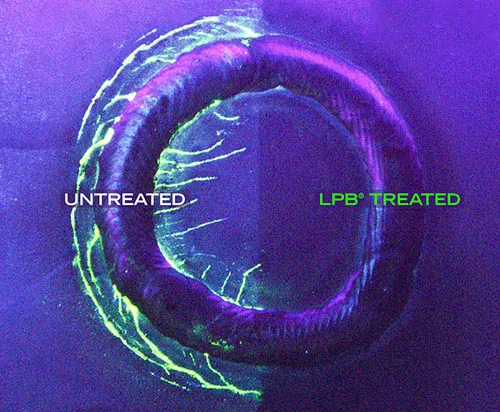
Low Plasticity Burnishing (LPB®) >.
is our patented and award-winning surface treatment solution used in thousands of critical components around the world.
Controlled Plasticity Burnishing (CPB™) >
is a variation on our award-winning LPB treatment, specifically designed for applications where low cold work isn’t necessary.
Controlled Impact Burnishing (CIB™) >
is a process to treat vulnerable areas of a component with highly controlled impacts to impart a deep, stable layer of beneficial compressive residual stress.
Deep
Rolling >
is a traditional burnishing process in which a tool is rolled across the surface with enough force to impart beneficial compressive residual stress.
Shot Peening Optimization >
is a service in which our engineers tailor the shot peening specifications of a part to achieve optimum fatigue results with the fastest processing times.
LPB® Frequently Asked Questions
What is Low Plasticity Burnishing (LPB)?
Short answer:
LPB is a precision surface treatment that introduces beneficial compressive stresses into the metal, significantly reducing the likelihood of cracking.
Technical detail:
Low Plasticity Burnishing (LPB®) is a mechanical surface enhancement process which uses a CNC-controlled rolling contact tool to impart a deep, stable compressive residual stress field into the surface of a component with very low associated cold work. LPB has been deployed in aerospace, energy, and medical applications for over 25 years.
How is LPB different from shot peening or laser shock peening (LSP)?
Short answer:
Compared with peening or LSP, LPB delivers deep compression with minimal cold work, a smoother finish, and repeatable CNC control. [3][5][9]
Technical detail:
- Shot peening: Shallow compression; High cold work; Uncontrolled process due to random distribution of impacts over a wide area; Compressive residual stresses relax when the part is subjected to relatively low temperatures compared to the typical annealing temperature; Compressive residual stresses relax at 1% plastic strain. [4][5]
- Laser shock peening (LSP): Deep compression; Complex ablative coating application required for low cold-work or smooth final surface; Without an ablative coating the laser produces square or circular dents in the part surface; Costly to scale. [3][5]
- LPB: Deep compression with inherent low-cold-work; Applied on conventional CNC machines and robots at speeds comparable to ball milling or lathe turning; Thermally and mechanically stable; Inherently smooth final surface; Inexpensive to scale. [3][5]
Takeaway: LPB imparts deep, stable compression with low cold work with repeatability—validated and approved by NASA, USAF, and FAA programs. [3][9]
How does LPB improve fatigue life?
Short answer:
LPB places the surface in residual compression, counteracting the tensile stresses applied in service and making it far more resistant to fatigue crack initiation and growth.
Technical detail:
Most fatigue failures initiate at or near the surface. The deep compressive layer from LPB offsets tensile stresses during operation, suppressing crack initiation and slowing Mode 1 fatigue crack growth. Actual performance improvement depends on the part’s specific alloy, geometry, and operating environment; Over 100X life increase has been documented in specific applications. [10]
Is LPB suitable for high-temperature environments?
Short answer:
Yes. The low cold work from LPB means its compressive stresses will hold up better at high temperatures and under repetitive loading. [3][4]
Technical detail:
Where highly cold-worked surfaces can relax rapidly at elevated temperatures, LPB’s low-cold-work stress fields have been proven to be thermally and mechanically stabile in turbine and reactor-adjacent alloys (e.g., Ti-6Al-4V, IN718). [3][4]
What materials can be treated with LPB?
Short answer:
Any metallic material
Technical detail:
LPB® can be applied to any metallic material, including aluminum, titanium, steels, Nickel-based alloys, copper alloys, zirconium, and more. The process parameters are tailored to the material properties of each alloy and geometry, ensuring optimal compressive stress without introducing excessive cold work. [3][11]
Does LPB affect surface finish?
Short answer:
Yes, it improves it. LPB naturally leaves a smooth, near-mirror finish.
Technical detail:
Because the process uses a polished, rolling tool head, LPB inherently reduces the surface roughness. If you require a specific texture, we can engineer the finish via tooling and process settings. [5][7]
Can LPB be applied to internal surfaces or complex geometries?
Short answer:
Yes. We design toolpaths and tooling for bores, fillets, threads, dovetails, blade edges, integrally bladed rotors, and other complicated shapes.
Technical detail:
LPB is delivered through CNC-controlled tooling, which can be engineered to access difficult areas. Custom tooling and process paths are developed for each application, ensuring that even difficult-to-reach stress concentrations (such as blade airfoil edges, holes, slots, or radii) can be effectively treated. [3][9]
Is LPB a qualified process for aerospace, defense, and medical applications?
Short answer:
Yes. LPB is used on both commercial and military flight-critical parts, and as a validated manufacturing step in FDA-cleared/approved medical implants. [3][10]
Technical detail:
LPB has been validated in NASA/USAF/FAA programs and implemented in production by major OEMs. It is also an accepted process of the US Air Force Engine Structural Integrity Program (ENSIP), MIL-HDBK-1783B. It is an FAA approved repair process. For medical devices, LPB is used as a validated manufacturing step inside FDA-cleared/approved implants (e.g., modular hip and knee prostheses). FDA adverse-event data cited by NASA and industry reports note no fretting-fatigue failures among LPB-processed modular implants over many years in clinical use. [3][10]
How does LPB compare to deep rolling or roller burnishing?
Short answer:
Traditional roller burnishing is used to improve finish and dimensional tolerance; Deep rolling adds more cold work and has less control than LPB. LPB delivers repeatable compression with minimal cold work, engineered to suit the part geometry and service stresses. [5][12]
Technical detail:
- Traditional Roller burnishing: A finishing process for dimensional tolerance and surface roughness improvement; Residual compression is not taken into consideration at all. [12]
- Deep rolling: Adds residual compression, but the amount of plastic deformation is not controlled. The resulting cold work can vary widely, reducing stability and repeatability. Force cannot be applied with sufficient precision, making the process unsuitable for many critical applications. [5]
LPB® imparts deep, stable compression with very low cold work and high repeatability. Residual stress fields are engineered to match the part’s material, geometry, and service stresses, with real-time parameter adjustments to account for geometric transitions and gradients in predicted service loads. [5]
Will the stresses relax in my application?
Short answer:
No the residual stresses from LPB will not relax in service. LPB stresses are designed for stability. The stresses from LPB can only relax if a part is subjected to the annealing temperature of the material or the part is deformed an extreme amount. [4][6]
Technical detail:
LPB is designed to be thermally and mechanically stable. Because the process introduces very low levels of cold work, the stresses are less susceptible to relaxation from creep, cyclic strain, or thermal exposure. LPB has been shown to maintain beneficial compression in applications involving sustained high temperatures, high stress, and corrosive conditions where shot peening stresses relax. [4][6]
What is “engineered compression”?
Short answer:
Designing and imparting a customized residual stress field into the surface of a part that will enhance part performance beyond what is achievable through typical manufacturing.
Technical detail (refined):
Engineered compression is the deliberate design and placement of a compressive stress field to counteract known damage drivers at specific features of a part. Service loads, operating conditions, damage mechanisms, and part geometry are translated into a 3D map of the required stress magnitude and depth. Highly controlled mechanical surface treatments (such as LPB®) then impart that stress field using CNC-controlled toolpaths at critical locations (ex: fillets, fastener holes, turbine blade edges, dovetail roots) so service stresses are offset where it matters most.
The resulting low cold work residual compression suppresses crack initiation and slows crack growth, making engineered compression a powerful design tool for extending component life. [9][13]
What damage mechanisms can be treated by LPB?
Short answer:
LPB prevents fatigue crack growth and initiation from all types of damage.
Technical detail:
Surface-initiated fatigue from all damage mechanisms requires the presence of tensile stress to initiate and propagate a Mode I fatigue crack. The deep, stable compression produced by LPB suppresses Mode I fatigue crack growth by replacing the tensile stresses normally present during operation with compressive residual stress. Damage to the surface like a dent, fretting crack, or corrosion pit act as stress risers where fatigue cracks begin. When LPB is applied, those same features are enveloped in a compressive stress field, removing the tensile stresses required for crack initiation or growth. As a result, LPB can effectively mitigate the fatigue debit from existing damage in fielded parts, improve damage tolerance in new-make parts, and extend component life. [5][7][8]
References
- Prevey, Paul S. Burnishing Method and Apparatus for Providing a Layer of Compressive Residual Stress in the Surface of a Workpiece. U.S. Patent 5,826,453, 27 Oct. 1998. Google Patents
- Prevey, Paul S. Method and Apparatus for Providing a Residual Stress Distribution in the Surface of a Part. U.S. Patent 6,415,486 B1, 9 July 2002. Google Patents
- Prevéy, Paul S., et al. “Case Studies of Fatigue Life Improvement Using Low Plasticity Burnishing in Gas Turbine Engine Applications.” ASME Turbo Expo 2003. NASA NTRS, 2003. NASA Technical Reports Server
- Prevey, Paul S. “The Effect of Cold Work on the Thermal Stability of Residual Compression in Surface-Enhanced IN718.” The Shot Peener Library (DTIC reprint), 2000. shotpeener.com
- Prevey, Paul S., Narayanan Jayaraman, and John Cammett. “Overview of Low Plasticity Burnishing for Mitigation of Fatigue Damage Mechanisms.” ICSP-9, 2005. CiteSeerX
- Prevey, Paul S., Michael J. Shepard, and Paul R. Smith. “The Effect of Low Plasticity Burnishing on the HCF Performance and FOD Resistance of Ti-6Al-4V.” AIAA Conference Paper, 2004. lambdatechs.com
- Prevéy, Paul S., et al. “Low-Cost Corrosion Damage Mitigation and Improved Fatigue Performance of LPB 7075-T6.” Lambda Technologies / Springer link, 2001–2008. lambdatechs.comSpringerLink
- Scheel, Jeremy E., et al. “Mitigation of Stress Corrosion Cracking in Nuclear Weldments Using Low Plasticity Burnishing.” ICONE16, 2008. lambdatechs.com
- Jayaraman, N., et al. “Mitigation of Fatigue and Pre-Cracking Damage in Aircraft Structures through Low Plasticity Burnishing (LPB®).” ASIP 2007 Proceedings, AFRL/VASM. asipcon.com
- NASA. “Burnishing Techniques Strengthen Hip Implants.” NASA Spinoff 2010 – Health and Medicine Brochure. 2010. NASA Spinoff
- NASA. “Surface Enhancement Improves Crack Resistance.” NASA Tech Briefs, 2002. NASA Technical Reports Server
- Hornbach, Douglas J., et al. “Application of Low Plasticity Burnishing (LPB®) to Improve the Fatigue Performance of Ti-6Al-4V Femoral Hip Stems.” ASTM STP, 2007. (Notes limits of conventional roller burnishing vs. LPB.) lambdatechs.com
- Prevéy, Paul S., et al. “Mitigation of Fretting Fatigue Damage in Blade and Disk Pressure Faces with Low Plasticity Burnishing.” Conference paper, c. 2008. lambdatechs.com